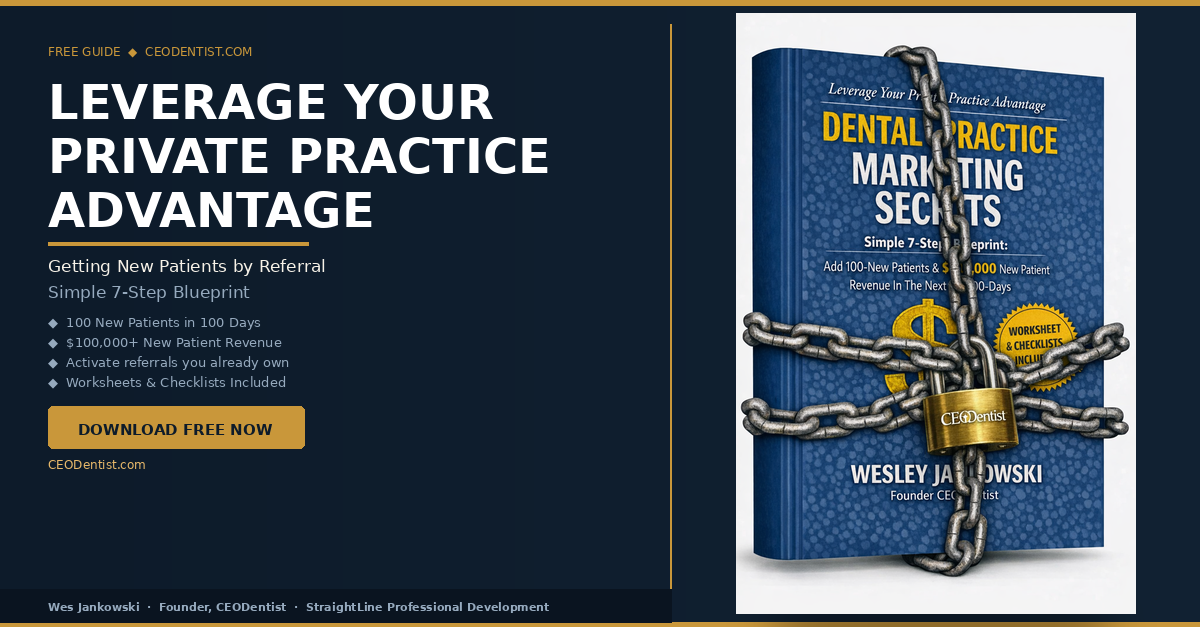
The Referral Reality Check: 90% of your patients have never referred a single person. Here's how to fix it.
There's a number sitting in your practice management system right now that most practice owners have never pulled.
It is not your production number. It is not your active patient count. It is not your new patient total for the last 12 months.
It is the number of your active patients who have referred even one person to your practice in the last year.
Pull that number. Compare it to your total active patient count. In virtually every private practice, the result is the same: fewer than 10% of active patients have made a single referral in the past year.
Which means 90% of the people who already know you, already trust you, and already drive past your competitors to sit in your chair — have never brought anyone with them.
That is the referral reality check. And it is the most important diagnostic exercise a private practice owner can run.
WHY THIS HAPPENS
Before diagnosing the problem, understand what it isn't. It is not that your patients are unhappy. It is not that they don't value your care. It is not that they wouldn't send someone if asked.
The research on this is consistent: most people don't refer not because they don't want to, but because nobody made it easy, nobody asked at the right moment, and the practice drifted out of their awareness between visits. Life is busy. Your patients are not thinking about your practice on a Tuesday afternoon in month four of a six-month recall cycle.
Relationships still outperform transactions. They always have. They always will. The private practice's structural advantage over corporate dentistry is the depth of the relationship a private practitioner can build with a patient over years of care. But that advantage only holds if the relationship is being actively maintained — not just during appointments, but between them.
THE HIDDEN NETWORK IN YOUR PATIENT BASE
In his landmark book How to Sell Anything to Anybody, Joe Girard — recognized by the Guinness Book of World Records as the greatest salesman in history — introduces what he called the Law of 250.
Girard discovered that every person knows approximately 250 people important enough to invite to the significant moments of their life. A wedding. A funeral. A milestone birthday. And those 250 people trust that person's recommendations.
For a dental practice, the implications are staggering.
A practice with 1,000 active patients has a warm referral network of 250,000 people — connected to the practice through the personal trust of someone who is already a patient. Cut that number in half for overlap. Cut it in half again. Cut it one more time for conservatism.
You still have over 31,000 people within reach — not through advertising, not through SEO, not through a Google review campaign. Through the personal credibility of the patients sitting in your chairs right now.
THE MATH THAT MOTIVATES
You do not need to reach all 31,000. You are looking for 100 motivated referrals per quarter — patients who come in because someone they trust told them to.
Using the ADA's documented average new patient first-year revenue: 100 referrals per quarter equals approximately $99,000 in additional production. Without a single dollar of additional external marketing. Without acquiring a single cold lead. From the warm network that already exists inside your patient base.
For a practice with 1,000 active patients, getting 100 referral-based new patients per quarter requires a referral rate of just 10% from your existing base. And your current rate — based on the reality check you ran earlier — is almost certainly under 10%.
The gap between where you are and where you could be is not a marketing problem. It is an activation problem.
WHAT ACTIVATION ACTUALLY LOOKS LIKE
The practices that successfully activate their referral network do five things consistently:
They maintain the relationship between visits. A brief, genuine touchpoint that communicates care without asking for anything.
They ask at the right moments. There are natural points in every patient visit where a referral ask converts at the highest rate — and most practices either never ask or ask at the wrong moment.
They make referring easy. Remove the friction. A card, a direct link, a named contact — dramatically increases follow-through.
They acknowledge and honor referrals. A patient who referred someone and was never thanked will not refer again.
They track the numbers. Referral sources, conversion rates, and referral patient retention all belong on the Bathtub Scoreboard.
THE PRIVATE PRACTICE ADVANTAGE
Here is what corporate dentistry cannot replicate at scale: a genuine, long-term, trust-based relationship between a doctor and a patient. The private practice dentist who has been treating a family for a decade has built something that no DSO marketing budget can buy.
That relationship is your competitive moat. It is also your most underleveraged growth asset.
The infrastructure for extraordinary growth already exists in your practice. It is sitting in your patient management system right now. The warm network is real. The trust is already there. The math is overwhelmingly in your favor.
The only question is whether you will activate it.
Run the referral reality check this week. Find your 10%. Then decide what you are going to do about the 90%.